Your Ultimate Long Island City Neighborhood Guide: What to Know in 2026
Long Island City in Queens has transformed from an industrial waterfront into one of New York City’s fastest-changing residential hubs. According to Niche, the neighborhood’s population has risen into the tens of thousands over the past decade, with dense clusters of new towers around Court Square and Hunters Point. This Long Island City neighborhood guide for 2026 outlines layout, housing, amenities, transit, and future development so residents and investors can evaluate opportunities with context rather than hype.
How Is Long Island City Laid Out in 2026?
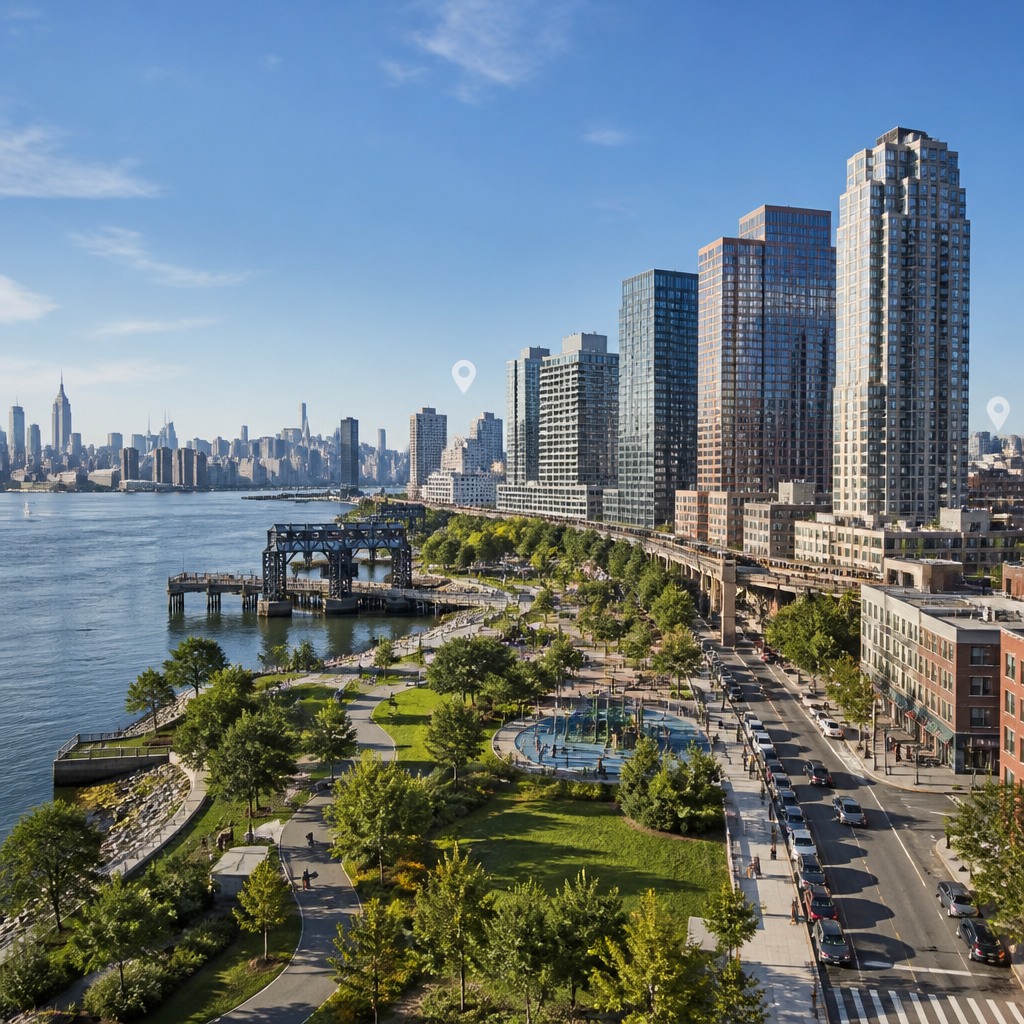
Long Island City stretches from the East River waterfront at Center Boulevard and Gantry Plaza State Park inland toward Queens Plaza and Dutch Kills. Vernon Boulevard forms a key north–south spine, while Jackson Avenue links Court Square with Queensboro Plaza and the Queensboro Bridge. According to Walk Score, Long Island City holds an overall walk score above 95, reflecting dense blocks where daily errands, dining, and parks often sit within a quarter-mile radius.
Waterfront parcels around Hunters Point South Park showcase glassy high-rise condominiums and rentals with sweeping Midtown views across the East River. Inland blocks near 21st Street, 44th Drive, and the industrial edges by Borden Avenue still include low-rise warehouses, loft conversions, and older multifamily stock. The contrast between Center Boulevard’s gleaming residential towers and the brick commercial buildings along 11th Street gives the neighborhood a layered visual character that continues to evolve parcel by parcel.
Twilight along Gantry Plaza State Park often brings soft orange light across the restored gantries and the calm slap of river water against the piers. The salty air mixes with the aroma of grilled food drifting from restaurants on Vernon Boulevard, while the rumble of trains on the Queensboro Bridge hums in the distance. Families push strollers along Center Boulevard, and the illuminated skyline over Midtown Manhattan turns the park’s concrete paths into reflective, shimmering corridors.
What Does the Long Island City Housing Market Look Like?
Long Island City includes luxury condominiums, high-rise rentals, and a shrinking set of prewar walk-ups around 46th Road and 21st Street. According to StreetEasy data through late 2024, asking rents in Long Island City frequently cluster in the $3,500 to $4,500 range for newer one-bedroom units, with some waterfront buildings commanding higher premiums. Entry-level condominiums near Murray Park often start in the $800,000 to $1,100,000 range, depending on view, amenities, and building age.
Based on listings tracked by Redfin through early 2025, total inventory in Long Island City often fluctuates between 150 and 250 active homes, including both resale and sponsor units. New development towers around Court Square and Hunters Point South continue adding supply, yet absorption remains strong due to demand from Manhattan and Brooklyn renters seeking shorter commutes. Sponsor concessions, such as one or two months of free rent, appear periodically when a new tower opens many units at once.
Several large condominium buildings, including The View at East Coast and Skyline Tower near Court Square, illustrate pricing tiers for full-service properties. According to building-level data reported through 2024, higher-floor units with direct river or skyline exposures can exceed $2,400,000. Smaller studios and one-bedrooms without river views in nearby towers frequently sell between $700,000 and $1,300,000, while older co-ops east of Jackson Avenue can trade at noticeable discounts relative to new construction.
What Everyday Amenities Define Life in Long Island City?
Long Island City residents benefit from an expanding mix of parks, cultural institutions, and daily conveniences. Gantry Plaza State Park and Hunters Point South Park offer lawns, athletic fields, and playgrounds along nearly a mile of waterfront. MoMA PS1 anchors the cultural scene near Jackson Avenue, while the sleek Hunters Point Library draws visitors with angled glass façades and reading terraces overlooking the East River. Supermarkets such as Foodcellar Market on Center Boulevard and Trader Joe’s near Jackson Avenue help keep daily shopping within a few blocks.
According to GreatSchools data updated through 2024, local public options like P.S./I.S. 78 at Center Boulevard and Academy for Careers in Television and Film on 36th Street receive ratings from 7/10 to 9/10 on several measures. LaGuardia Community College near Thomson Avenue adds a steady student presence. Smaller green spaces such as Murray Park, Queensbridge Park north of the Queensboro Bridge, and Dutch Kills Green near Queens Plaza provide pocket-park relief inside an increasingly vertical environment.
Weekend mornings along Vernon Boulevard carry the smell of coffee from Partners Coffee and warm pastries from LIC Market, while the clink of dishes drifts from brunch tables on 50th Avenue. Sunlight reflects off glass towers near Court Square, casting shifting patterns onto older brick façades along 44th Drive. Inside MoMA PS1’s courtyard, echoing music and murmured conversations bounce between concrete walls, giving the block a layered soundscape that contrasts sharply with the quieter side streets near Murray Playground.
How Convenient Is Transit and Commuting from Long Island City?
Transit access remains one of Long Island City’s strongest advantages. According to Walk Score transit data for 2024, the neighborhood earns a transit score above 90, reflecting extensive subway and bus coverage. The E, M, and R lines converge at Queens Plaza, while the 7, N, and W trains stop at Queensboro Plaza. Court Square connects the E, G, M, and 7 trains, creating multiple one-stop routes into Midtown Manhattan and key Brooklyn destinations.
Travel times to central employment nodes are short by New York standards. The 7 train covers the distance from Vernon Boulevard–Jackson Avenue to Grand Central–42nd Street in roughly 5 to 7 minutes during typical weekday schedules, based on timetables from the MTA. East River NYC Ferry service from Hunters Point South to East 34th Street often takes about 8 minutes, with additional routes to Wall Street and Brooklyn Navy Yard providing alternative commute options during subway disruptions.
Road access through the Queensboro Bridge, the Long Island Expressway, and the Pulaski Bridge allows drivers and cyclists to move between Long Island City, Midtown East, and Greenpoint within a few miles. Citi Bike stations cluster around Center Boulevard, Vernon Boulevard, and Court Square, enabling short trips to Astoria and Greenpoint in under 15 minutes. However, congestion on Jackson Avenue and around Queens Plaza during peak hours keeps reliable subway and ferry access central to most residents’ daily routines.
What Development Trends Are Shaping Long Island City’s Future?
Development in Long Island City continues at a rapid pace following rezoning initiatives that began in the early 2000s. According to projections from the New York City Department of City Planning, waterfront and transit-adjacent parcels are expected to accommodate thousands of additional residential units through the late 2020s. Towers near Court Square, Queens Plaza, and Hunters Point South extend the skyline each year, adding new retail podiums, school space, and public plazas at street level.
Planned enhancements around the Queens Plaza and Dutch Kills Green corridors aim to balance density with improved pedestrian safety and open space. Streetscape work around Jackson Avenue and 43rd Avenue continues to introduce curb extensions, bike lanes, and new lighting. According to NYCEDC updates through 2024, city agencies have targeted millions of dollars in infrastructure investment toward sewer upgrades, waterfront resiliency, and school capacity in and around Long Island City, supporting long-term residential growth.
Commercial development also plays a role in neighborhood evolution. Office repositioning in former industrial buildings along 47th Avenue and Pearson Street has attracted creative firms and technology tenants. Hotels near Queensboro Plaza and along Northern Boulevard extend hospitality capacity for visitors. As new construction progresses, questions around affordability, school crowding, and transit capacity remain central to local discussions, ensuring that community boards and neighborhood organizations remain active stakeholders in shaping Long Island City’s trajectory.
How Should Prospective Residents and Investors Evaluate Long Island City in 2026?
Evaluating Long Island City in 2026 requires attention to micro-locations around distinct sub-areas such as Hunters Point, Court Square, Queens Plaza, and Dutch Kills. Waterfront towers along Center Boulevard often command the highest prices and common charges due to direct skyline views and amenity packages that can include pools, roof decks, and full-time concierges. According to StreetEasy rental data for late 2024, new luxury rentals in prime riverfront buildings can exceed monthly asking levels of $5,000 for larger layouts.
In contrast, walk-up and elevator buildings east of Vernon Boulevard toward 21st Street and Ravenswood often provide relatively lower price points at the cost of longer walks to the waterfront parks. Potential investors frequently weigh projected rent levels against common charges and tax abatements, particularly in buildings where programs like 421-a are expiring. As incentives phase out, carrying costs can climb several hundred dollars per month, influencing long-term return calculations more than headline purchase prices alone.
Quality-of-life considerations also shape decisions. Proximity to Gantry Plaza State Park, MoMA PS1, Hunters Point Library, and schools like P.S./I.S. 78 or Academy for Careers in Television and Film can influence perceived value as strongly as square footage. Residents attentive to train noise near elevated segments by Queensboro Plaza or bridge traffic along Queens Plaza South often focus on interior layouts, window quality, and building orientation to manage sound levels, enhancing comfort in a dense, transit-rich neighborhood.
The population growth cited at the start of this guide reflects sustained demand for housing and amenities in Long Island City, while the walk and transit scores above 90 underscore how integrated the neighborhood has become with the wider city. The StreetEasy Long Island City dashboard provides continuously updated data on inventory, asking prices, and concessions that clarify changing conditions. Prospective residents and investors who register listing alerts through that dashboard and commit to touring viable homes within 48 hours of listing activation before the spring 2026 leasing and buying surge position themselves to secure stronger terms, while those delaying engagement until after that seasonal pivot often face tighter choices, steeper competition, and higher effective monthly housing costs.
FROM OUR BLOG


Buying a Home in Brooklyn NY: Essential Tips for 2026
Buying a Home in Brooklyn NY: Essential Tips for 2026 Buying a home in Brooklyn NY in 2026 requires understanding a fast-moving market with limited inventory and strong demand. According to Zillow, the typical Brooklyn home value stood in the mid-$900,000 range as of late 2024, after several years o
Discover the Best Apartments for Rent in Long Island City: 2026 Guide
Discover the Best Apartments for Rent in Long Island City: 2026 Guide Long Island City has transformed into one of New York’s most in-demand rental corridors, with sleek towers lining the East River and converted warehouses along Vernon Boulevard. According to StreetEasy, average asking rents for Qu

Ridgewood NY Residential Sales: Market Trends and Insights for 2026
Ridgewood NY Residential Sales: Market Trends and Insights for 2026 Ridgewood NY residential sales entering 2026 reflect a maturing outer-borough market with sustained demand from both Brooklyn and Manhattan commuters. According to Walk Score, Ridgewood posts a Walk Score around 92, signaling strong